25 Digital Sales Room Use Cases Across 5 Industries (2026)
Most articles about digital sales rooms read the same. A list of features. A pitch about buyer engagement. A vague claim that DSRs work for everyone.
That is not how sales teams evaluate software.
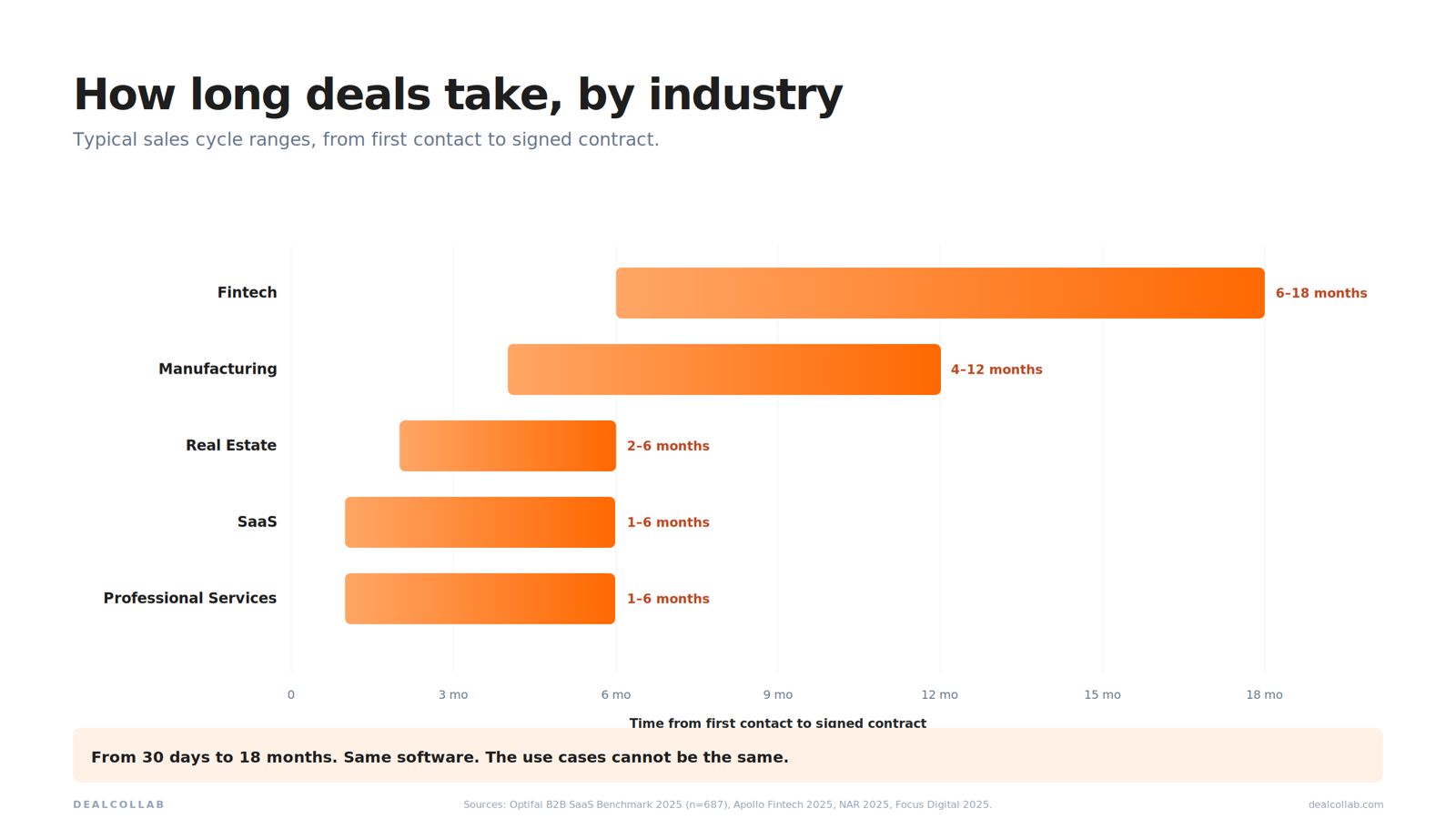
The first question a serious evaluator asks is whether the tool fits how their industry sells. A SaaS team running 30-day cycles has nothing in common with a manufacturing team running 18-month procurement processes. A fintech team selling to compliance officers has nothing in common with a real estate broker selling to a buyer walking through a property.
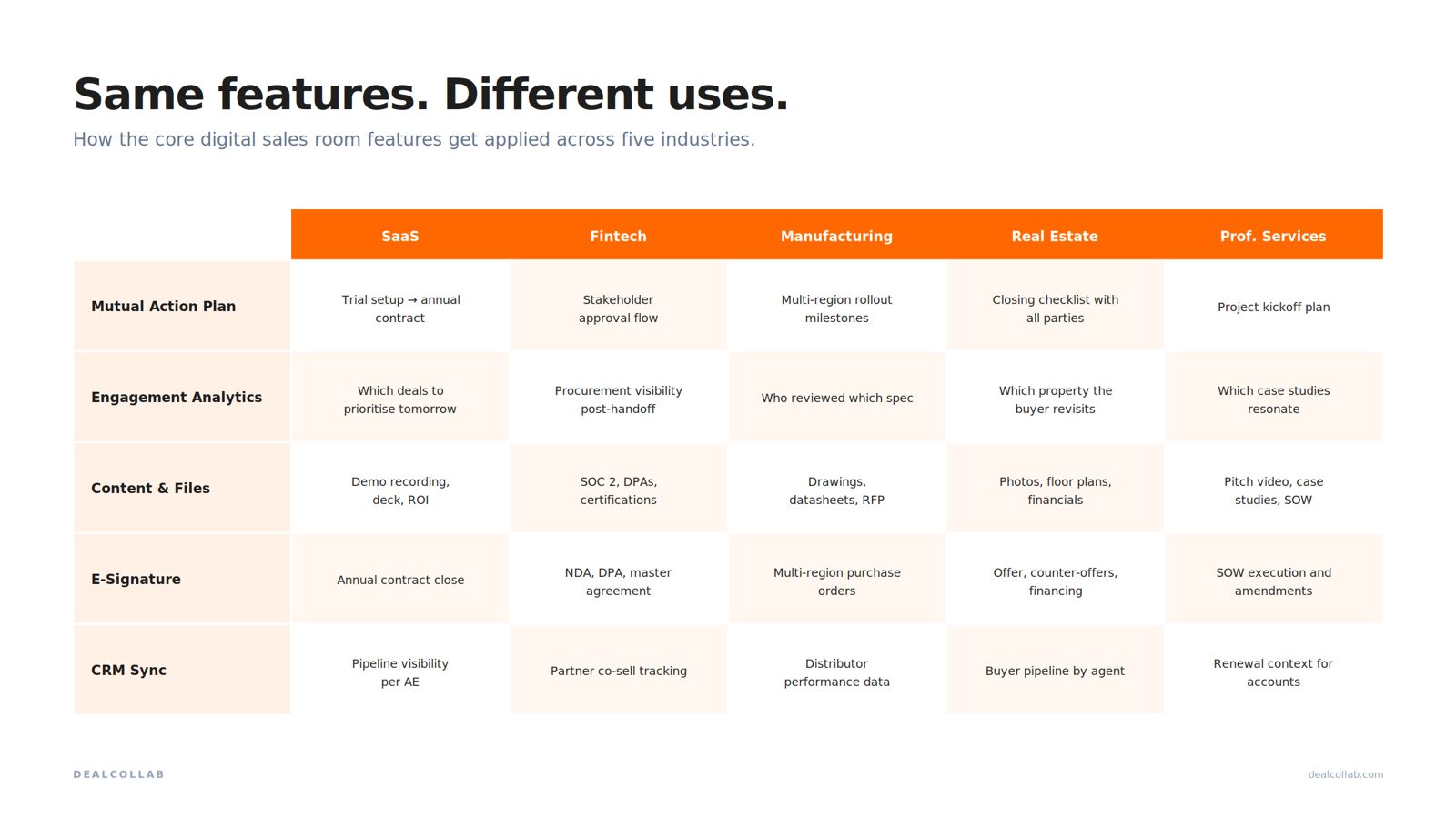
The feature list is the same. The use cases are not.
This guide breaks down 25 specific ways digital sales rooms get used across five industries: SaaS, fintech, manufacturing, real estate, and professional services. Each one follows the same structure. The scenario, the problem, the DSR solution, the outcome.
If you want the foundational guide on what a digital sales room is and which features matter, start with our complete guide to digital sales rooms. If you already know what a DSR is and you want to see how teams in your industry actually use one, keep reading.
1.SaaS
SaaS sales cycles are short by B2B standards. Demos happen fast. Procurement is light. Buying committees are small but technical. The challenge is rarely stakeholder count. It is response speed, clean handoffs, and not letting deals stall in week two of a free trial.
Post-demo follow-up that gets opened
After a demo, the AE sends one room with the recording, the deck, the pricing, and a mutual action plan. The buyer no longer hunts through three follow-up emails. The AE sees who watched the recording and which section of the proposal was opened twice.
Outcome: the AE knows which deals to prioritise the next morning instead of guessing from radio silence.
Free trial conversion
Sales-led trials usually die in week two when the champion stops responding. A DSR keeps the conversation in one place. The room contains the trial setup guide, weekly check-in notes, ROI examples, and a path to an annual contract. When the champion needs to forward something to their CFO, they share one link, not a folder.
Outcome: trial-to-paid conversion improves because the buying journey is visible to the seller and easy to forward internally.
Sales-to-CS handoff
The same room used to close the deal becomes the onboarding workspace. The CSM inherits the full sales context. The customer does not start over. The mutual action plan converts into the implementation plan.
Outcome: faster time to value, and fewer "what was promised in the sales process" surprises in week six.
Renewal preparation
The CSM builds a renewal room 90 days before the contract date. Inside: usage stats, milestones hit, ROI achieved, and a renewal proposal. The customer sees the value before they see the bill.
Outcome: shorter renewal conversations and fewer last-minute discount requests.
Multi-product expansion
The account manager creates a focused room around a single new product, not the whole portfolio. The room shows the customer's existing usage, where the new product fits, and an ROI calculation tied to their data.
Outcome: cross-sell conversations land as logical next steps, not as a generic upsell pitch.
2.Fintech
Fintech sales involve more compliance, more security review, and more stakeholders than typical SaaS. The buyer is rarely the end user. Procurement, infosec, and legal usually shape the timeline more than the sponsor does.
Security and compliance review
The room hosts SOC 2 reports, penetration test summaries, data processing agreements, and regulatory certifications in one place. When infosec joins the conversation in week six, they get a single link instead of a string of email attachments and follow-up requests.
Outcome: security review cycles compress because the documentation lives where the deal lives.
Multi-stakeholder approval flow
Fintech buying committees usually include a sponsor, a head of risk, a compliance officer, and a CFO. The DSR shows who has reviewed which materials. The sponsor sees gaps. The seller sees blockers without asking.
Outcome: the seller stops chasing "who else needs to see this" because the room shows it.
Pilot to production transition
Many fintech deals start with a paid pilot. The pilot has its own scope, data, and success metrics. The DSR captures all three. When the pilot ends, the same room hosts the production proposal with the pilot results embedded right above it.
Outcome: pilot-to-production decisions happen in days, not weeks of internal debate.
Procurement handoff
When the deal moves to procurement, the AE often loses visibility. A DSR with all commercial documents, vendor questionnaires, and reference materials gives procurement everything they need without back-channel emails.
Outcome: procurement closes faster because they have what they need on day one.
Partner co-selling
Fintech often sells through banks, brokers, or consultants. A white-labeled DSR lets the partner manage the buyer experience while the vendor retains visibility into engagement and content usage.
Outcome: the partner closes faster. The vendor keeps the data.
3.Manufacturing
Manufacturing sales cycles are long. Stakeholders include engineering, procurement, plant managers, and finance. Deals often involve site visits, technical specifications, and pilot installations. Email and PDF break down here faster than in any other industry.
Technical specification management
Engineering teams need access to drawings, datasheets, certifications, and integration documents. A DSR holds the latest version of every spec in one place. When the customer's engineering team asks a question, the seller does not chase a folder. They update the room.
Outcome: technical reviews stop stalling on outdated documents.
RFP response
Most manufacturing deals run through formal RFPs. A DSR hosts the response, supporting documents, references, and pricing in one buyer-facing space. The procurement team can review and share without 40-page email attachments.
Outcome: RFP responses stand out because the buyer experience is clean, not because the answer is longer.
Site visit follow-up
After a plant tour or site visit, the sales engineer shares a room with photos, technical findings, recommended configurations, and a proposal. The buyer team that did not attend gets the full context.
Outcome: site visits convert more often because the people not on the floor see what the people on the floor saw.
Multi-region rollout planning
When a manufacturer buys equipment for ten plants across four countries, the deal becomes a project. The DSR holds the rollout plan, regional contracts, local language documentation, and implementation milestones.
Outcome: large rollouts stay coordinated without the central team running a master spreadsheet.
Distributor enablement
Manufacturers often sell through regional distributors. A shared DSR template gives every distributor a consistent way to present the product, share specifications, and submit deals back to the manufacturer.
Outcome: distributor performance becomes measurable. Buyer experience stays consistent across regions.
4.Real Estate
Commercial and residential real estate sales involve high-value transactions, multiple stakeholders, financial documentation, and emotional decisions. Buyers expect a polished experience. Sellers compete on responsiveness.
Property package for serious buyers
Instead of a PDF brochure, the agent shares a property room. Inside: photos, floor plans, a video walkthrough, neighbourhood data, financial projections, and the offer template. The buyer experience reflects the price tag.
Outcome: serious buyers self-qualify faster because they have everything in one place.
Investor pitch room
For commercial property, the broker builds an investor-specific room with rent rolls, cap rate analysis, comparable sales, and financing options. The room is shareable with the investor's accountant, lawyer, and partners without any of them needing an account.
Outcome: investor due diligence accelerates because the documentation is structured, not scattered.
Multi-property tour planning
When a buyer is evaluating five properties, each property gets its own room. The agent tracks which property the buyer revisits most. The next conversation is informed, not generic.
Outcome: agents focus their effort on the properties the buyer actually wants, not the ones the agent thinks the buyer wants.
Offer negotiation
Once an offer is on the table, the room becomes the workspace. Counter-offers, contingency documents, financing letters, and signature blocks all live in one link. Both sides see the latest version.
Outcome: offer cycles compress. The back-and-forth stops happening over text messages.
Closing coordination
Real estate closings involve a buyer, a seller, two agents, two attorneys, an inspector, an appraiser, and a title company. The DSR holds the closing checklist with every party's tasks. Nobody asks "where are we" because the answer is in the room.
Outcome: closings happen on time more often because nobody is the bottleneck nobody noticed.
5.Professional Services
Agencies, consulting firms, and other professional services firms sell trust and outcomes, not products. The pitch process is heavy on case studies, scoping documents, and team credentials. Deals close on credibility.
Pitch and proposal delivery
Instead of a static deck and a written proposal, the agency shares a room with the pitch video, case studies relevant to the prospect's industry, team bios, and the proposal. The buyer experience matches the brand.
Outcome: agencies win pitches against bigger competitors because the experience feels custom, not templated.
Scoping and statement of work
The DSR hosts the discovery findings, the proposed approach, the timeline, the team, and the SOW. As scope evolves, the room updates. The client sees the latest version, not yesterday's.
Outcome: SOW negotiations close faster because both sides work from one document, not five email attachments.
Client onboarding
Once the deal closes, the same room transitions into onboarding. The kickoff plan, key contacts, asset uploads, and milestones live in one place. The client never has to ask where to send something.
Outcome: project kickoffs feel professional from day one, which protects renewal economics.
Project status and reporting
For ongoing engagements, the room becomes a project portal. Weekly status updates, deliverables, and meeting recordings live in one place. The client sees progress without the agency sending a status email every Friday.
Outcome: client relationships stay strong because visibility replaces the perception of "what are we paying for."
Renewal and expansion
When the engagement is up for renewal, the room hosts a year-in-review summary with deliverables, outcomes, and a proposed next phase. The conversation starts from value, not from price.
Outcome: renewal rates improve. Expansion conversations happen earlier
What Every Industry Has in Common
Five industries. 25 use cases. Different scenarios. Same pattern.
In every case, the buyer experience used to mean scattered emails, attached PDFs, and follow-up calls trying to figure out what the buyer was thinking. The deals that closed did so despite the process, not because of it.
Digital sales rooms replace that with one shared workspace. The seller sees engagement. The buyer finds everything in one link. The deal moves forward because the friction is gone, not because the seller is doing more work.
The use cases vary. The principle does not.
DealCollab: Built for Real Use Cases, Not Feature Demos
Most digital sales room tools were built to win feature comparisons. The marketing leads with AI, sales coaching, and revenue intelligence. The actual usage in production is much smaller. Shared rooms. Mutual action plans. Engagement tracking.
DealCollab was built around the use cases above.
Whether you sell SaaS subscriptions in a 30-day cycle or industrial equipment in an 18-month cycle, the core need is the same. One shared link. Clean content delivery. Mutual action plans. Engagement analytics. CRM integration.
DealCollab does those well, charges a flat team rate, and stays out of the way of teams that just want to close deals.